
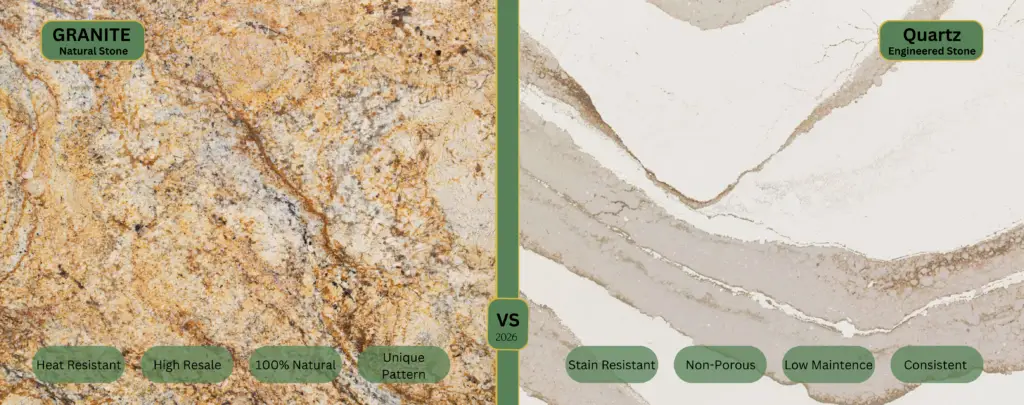
If you’re planning a kitchen remodel in 2026, you’ve almost certainly hit the same crossroads: quartz vs. granite countertops. Both materials are beautiful, durable, and in high demand — but they’re not created equal. Choosing the wrong surface can cost you thousands of dollars, hours of maintenance, and years of quiet regret every time you set a hot pan down.
This guide cuts through the noise. We compare quartz and granite head-to-head across every category that matters — durability, cost, maintenance, heat resistance, appearance, eco-friendliness, and long-term home value — so you can walk into any showroom with total confidence.
Quick Answer: Quartz wins on low-maintenance practicality; granite wins on natural beauty, heat tolerance, and resale prestige. Your lifestyle determines the real winner.
Table of Contents
1. What Is Quartz? (And What It Isn't)
Quartz countertops are engineered stone surfaces made from approximately 90–94% ground natural quartz crystals bound together with polymer resins, pigments, and occasionally recycled glass or metallic flecks. Brands like Cambria, Silestone, and Caesarstone dominate the market.
Because quartz slabs are manufactured in a controlled environment, the results are predictable: uniform color, consistent patterning, and guaranteed non-porosity right out of the factory. There’s no need to seal quartz — ever. That’s a major selling point for busy households.
Key Quartz Facts for 2026:
-
Non-porous surface — bacteria and moisture cannot penetrate
-
Available in hundreds of colors and patterns, including convincing marble and concrete looks
-
Consistent appearance across multiple slabs — perfect for large islands
-
Flexural strength exceeds most natural stones under everyday stress
2. What Is Granite? A Primer on Natural Stone
Granite is a natural igneous rock formed over millions of years deep within the earth’s crust. It’s composed primarily of quartz, feldspar, mica, and other minerals — and every single slab pulled from the quarry is completely unique. No two granite countertops on the planet are identical.
Granite has been a prestige countertop material for decades, and in 2026 it remains the benchmark that all other surfaces are measured against in luxury real estate. It’s dense, hard, and — when properly maintained — extraordinarily durable.
Key Granite Facts for 2026:
-
Naturally heat-resistant — handles hot pots and pans better than quartz
-
Unique veining and mineral patterns make every installation one-of-a-kind
-
Porous surface requires sealing once every 1–3 years
-
Available in hundreds of naturally occurring colors and patterns
3. Head-to-Head Comparison Table
|
Category |
Quartz |
Granite |
Winner |
|
Durability |
Excellent |
Excellent |
Tie |
|
Heat Resistance |
Moderate |
High |
Granite ✓ |
|
Stain Resistance |
High (non-porous) |
Moderate (porous) |
Quartz ✓ |
|
Maintenance |
Low (no sealing) |
Medium (needs sealing) |
Quartz ✓ |
|
Appearance |
Consistent look |
Unique natural slab |
Granite ✓ |
|
Cost (per sq ft) |
$50–$120 |
$45–$200+ |
Quartz (avg) |
|
Eco-Friendliness |
Engineered product |
Natural stone |
Granite ✓ |
|
Resale Value |
High |
Very High |
Granite ✓ |
4. Durability: Which Surface Holds Up Longer?
Both materials score extremely high on the Mohs hardness scale — granite typically rates between 6 and 7, while quartz engineered stone comes in at around 7. For everyday kitchen use, both will resist scratches from normal cooking activities with equal effectiveness.
Where they diverge is in impact resistance. Granite can occasionally crack or chip along natural fissures if struck sharply at an edge, especially in thinner 2cm slabs. Quartz, being engineered with resin binders, tends to be slightly more flexible and less susceptible to edge chipping.
However, quartz has a notable long-term vulnerability: UV exposure. Prolonged direct sunlight causes the resin binders to yellow and discolor over time. This makes granite the superior choice for outdoor kitchens, sunlit breakfast bars, or any surface near large windows with direct sun exposure.
Verdict: For indoor kitchens, both materials offer equivalent longevity. For outdoor or high-UV environments, choose granite.
5. Heat & Scratch Resistance
Heat Resistance
This is one of the most consequential differences between the two materials — and granite wins clearly. Natural granite can tolerate temperatures up to 1,200°F without damage. You can set a cast-iron skillet straight off the burner onto granite without hesitation.
Quartz, by contrast, contains resin binders that begin to discolor and even warp at temperatures above 300°F. Placing a hot pan directly on quartz can cause permanent thermal shock marks — a damage type that is not repairable. Trivets are non-negotiable with quartz countertops.
Scratch Resistance
Both surfaces resist scratches well under normal conditions. However, quartz’s engineered consistency means scratch resistance is uniform across the entire slab. Granite’s natural composition can create localized soft spots in areas of high feldspar concentration, making some areas marginally more susceptible to surface scoring over time.
Verdict: Granite is the clear winner for heat resistance. For scratch resistance, both are comparable in everyday use.
6. Stain Resistance & Maintenance Requirements
Stain Resistance
This category is quartz’s strongest suit. Because quartz is non-porous, liquids cannot soak into the surface — meaning red wine, coffee, olive oil, and acidic citrus juices wipe clean without leaving a trace. No sealing required, ever.
Granite is naturally porous, meaning spills left unattended can seep into micro-fissures and permanently stain the stone. Acidic liquids like lemon juice and vinegar can etch the surface over time. Regular sealing — typically once per year for high-use surfaces — is essential to protect granite’s appearance and hygiene.
Day-to-Day Cleaning
Quartz requires only mild soap and water or a gentle stone cleaner. Harsh chemicals like bleach or abrasive scrubbers should be avoided, as they can degrade the resin over time, but general maintenance is minimal.
Granite cleaning is equally simple for daily use, but the annual sealing ritual adds a maintenance step that some homeowners find burdensome. Skip the seal and you risk irreversible damage.
Verdict: Quartz wins on stain resistance and low maintenance. Ideal for households with children, frequent entertainers, or anyone who doesn't want to think about countertop care.
7. Cost Breakdown: Quartz vs. Granite in 2026
In 2026, both materials sit in a similar price range, though granite spans a wider spectrum. Here’s what to expect:
Quartz: $50–$120 per square foot installed. Mid-range slabs from major brands like Cambria or Silestone typically fall in the $70–$95 range. Premium patterns with large veining can push past $120.
Granite: $45–$200+ per square foot installed. Entry-level granite from common varieties (like Uba Tuba or Baltic Brown) starts around $45. Exotic quarried slabs — Brazilian Blue, Taj Mahal, or Van Gogh granite — can easily exceed $200 per square foot.
For a standard 30-square-foot kitchen island, expect to budget $2,100–$3,600 for quartz and $1,350–$6,000+ for granite depending on the slab selected. Fabrication and installation costs are comparable between the two materials.
Cost Tip: If budget is your primary constraint, entry-level granite is often the most affordable premium countertop option. If you want cost predictability with consistent quality, quartz delivers more uniform pricing.
8. Aesthetics: Consistency vs. One-of-a-Kind Character
Here the two materials reflect fundamentally different design philosophies, and the right choice depends entirely on your personal taste.
Quartz delivers predictability. Because slabs are manufactured, you can order multiple pieces for a large kitchen and achieve a perfectly matched, continuous look. Quartz now mimics natural marble, concrete, and even exotic stones with remarkable accuracy — making it the top choice for modern minimalist and Scandinavian-inspired kitchen designs.
Granite delivers personality. Each slab is a geological fingerprint: no two pieces from the same quarry are identical. The depth of mineral crystals, the sweep of natural veining, the play of light across the surface — these qualities are simply impossible to replicate artificially. For homeowners who want a kitchen that feels alive and irreplaceable, granite is unmatched.
Design Trend Watch 2026: Waterfall island edges have driven significant quartz adoption in contemporary kitchens, as the consistent patterning wraps corners seamlessly. For transitional and traditional kitchen styles, granite remains the top design choice among high-end renovation clients.
9. Environmental Impact
Sustainability has become an increasingly important factor in 2026 purchasing decisions, and the two materials have very different environmental profiles.
Granite is a natural material quarried directly from the earth. While quarrying operations have environmental costs — land disruption, energy-intensive extraction, long transportation distances — granite requires no synthetic binders, generates no off-gassing, and has a centuries-long functional lifespan.
Quartz is an engineered product. The manufacturing process consumes significant energy and uses polyester resins derived from petrochemicals. However, some manufacturers have introduced recycled-content quartz using post-industrial glass and stone waste, which improves its sustainability profile meaningfully.
Verdict: Granite has a lighter chemical footprint and is a fully natural product. If sustainability is a priority, granite edges ahead — though both materials are durable enough to last decades, reducing replacement waste.
10. Resale Value & ROI
When it comes to home resale value, both countertop materials are considered premium upgrades over laminate or tile, but granite carries a slight prestige edge in the real estate market.
According to multiple real estate valuation studies, granite countertops consistently feature in the top five interior upgrade keywords that appeal to luxury buyers. Agents in major markets report that granite — especially exotic varieties — commands buyer attention in a way that engineered stone does not.
That said, quartz resale performance has improved dramatically over the past decade as consumer familiarity with the material has grown. In markets dominated by young professional buyers who prioritize low-maintenance living, quartz can actually be the more appealing selling point.
Bottom Line: Both materials offer solid ROI for kitchen renovations. Granite edges ahead in luxury-tier markets; quartz is increasingly competitive in mid-range and urban markets.
11. Which Countertop Is Right for You? (Use-Case Guide)
Choose Quartz if you:
-
Have young children or a busy, high-traffic kitchen
-
Entertain frequently and need easy cleanup
-
Want a consistent, modern aesthetic across large surfaces
-
Prefer zero annual maintenance
-
Are designing a contemporary, minimalist, or Scandinavian-style kitchen
Choose Granite if you:
-
Cook frequently and need genuine heat tolerance
-
Want a truly unique, one-of-a-kind surface
-
Have an outdoor kitchen or high-sun exposure area
-
Are renovating a traditional, transitional, or farmhouse-style kitchen
-
Want maximum resale appeal in a luxury real estate market
-
Prefer natural materials with minimal synthetic processing
12. Frequently Asked Questions
Is quartz more expensive than granite in 2026?
Not necessarily. Entry-level granite is often cheaper than mid-range quartz. However, quartz pricing is more predictable — you’re less likely to encounter surprise costs from exotic slab selection or pattern matching.
Does granite need to be sealed every year?
Most granite countertops benefit from sealing once every one to three years, depending on usage intensity and the porosity of the specific stone variety. High-use surfaces around sinks and cooktops may need annual attention.
Can you put a hot pan on quartz?
No. Quartz contains resin binders that can discolor, crack, or warp when exposed to temperatures above approximately 300°F. Always use trivets or heat-protective pads on quartz surfaces.
Which countertop is better for bathrooms?
Quartz is generally preferred for bathroom countertops due to its non-porous surface, which resists the moisture, soap scum, and beauty product spills common in bathroom environments.
Is granite out of style in 2026?
Absolutely not. While quartz adoption has grown significantly over the past decade, granite — particularly exotic and rare varieties — remains a top choice in luxury kitchen renovations and continues to command strong buyer interest in the real estate market.
13. Final Verdict: Quartz vs. Granite in 2026
After examining every dimension that matters to homeowners and renovators in 2026, here’s the honest conclusion: there is no universal winner — but there is a right answer for your specific life.
Quartz is the smarter choice if you want a virtually maintenance-free, stain-resistant surface with predictable aesthetics and a modern sensibility. It’s the countertop for people who cook hard, live busy, and don’t want to think about their surfaces.
Granite is the more rewarding choice if you value natural beauty, genuine heat tolerance, uncompromised uniqueness, and the centuries-old prestige of stone pulled from the earth. It rewards attentive ownership with a surface that only gets more beautiful with age.
In 2026, the real question isn’t which material is objectively better — it’s which material fits the rhythm of your life, the design of your home, and the vision you have for the space where you cook, gather, and live.
Ready to choose? Take your lifestyle priorities into the showroom, order samples of both materials in your top color choices, and live with them in your kitchen light for at least a week before committing. Your countertop is a 20-year decision — it deserves 7 days of consideration.